


Loft Bedroom Colour Schemes for Low Ceilings and Sloped Walls
A low ceiling and a slope that begins somewhere near your pillow are not problems so much as constraints to work with. Handle the colour scheme properly and a compact loft bedroom reads as calm, deliberate and surprisingly airy. Handle it badly — brilliant white overhead, a heavy colour on the walls below it — and the room shrinks every time you climb the stairs.
The encouraging part is that almost everything here comes down to paint and a couple of clever choices about where contrast sits. No structural work, no specialist trades, no dramatic spend.
Start with the ceiling, not the walls
Most people pick a wall colour first and treat the ceiling as an afterthought. In a loft, that is backwards. The sloped plane is often the largest surface you see from the bed, and a hard tonal line where it meets a coloured wall advertises the change in pitch. Take the same colour from the walls up over the slope and across the flat ceiling instead, and the eye reads one continuous surface. The room feels taller because it stops announcing where it gets shorter.
If you want a little definition, drop one shade lighter on the slope and flat ceiling rather than switching to plain white. Many brands will tint a lighter version of the same colour, or mix a percentage of the base. Warm off-whites, soft greiges and chalky greens work far harder in a loft than brilliant white, which has nothing to bounce back in a room with limited daylight and turns cold and grey in shadow.
Colours that hold up in low light
Loft rooms usually have one glazed wall, a roof window or a dormer, and a lot of shadow. Colours with a little warmth and a decent amount of grey in them behave best.
- Warm off-whites and oatmeal. The safe pair of hands. Look for names with "almond", "linen" or "clay" in them rather than anything labelled brilliant or pure white.
- Muted sage and olive greens. Calming, flattering with natural light, and forgiving of the slightly odd angles in a conversion.
- Soft blues and slate greys. Choose the dusty end of the spectrum. A clear, saturated blue on a sloped wall can feel cold once the sun has moved round.
- Mushroom, taupe and greige. Excellent on the biggest slope, because these tones don't glare when daylight rakes across them.
- Clay, plaster pink and soft terracotta. Warming, and they make a north-facing loft feel less clinical.
Buy tester pots and paint generous patches — lining-paper size — directly onto the sloped wall. Check them in the morning, in the late afternoon and with the lamp on at night. The slope catches light differently from the vertical walls, so a colour you love downstairs can look quite different up here.
Where the dark should go
Contrast is useful, but placement decides whether it helps. A deep colour on the wall opposite the bed pushes that wall away and makes the room feel deeper. The same colour on the slope above your head does the reverse: it drops the ceiling towards you and can feel oppressive when you are lying underneath it. Keep the angled surfaces quiet and matte, and spend your contrast on vertical walls.
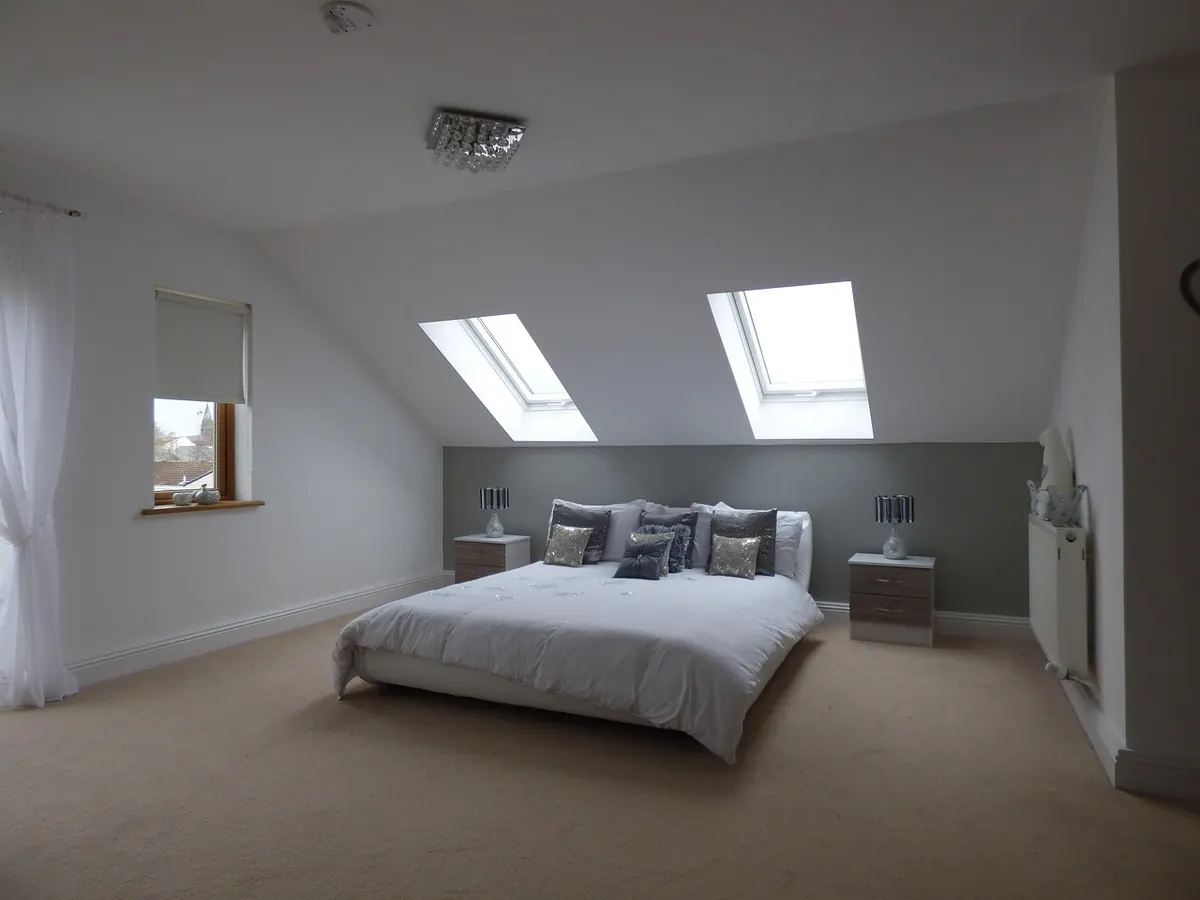
A dark headboard wall behind the bed is a reliable move — it frames the bed, adds depth and gives a small room a focal point. If you have a low knee wall with eaves storage behind it, painting that dark makes it recede while the lighter slope above appears to lift. Painting skirting, doors and architraves the same colour as the walls blurs the edges of the room and stops your eye bouncing around the perimeter. Horizontal bands do the opposite, so a dark dado, a strong picture rail or a stripe of contrasting tile will flatten the space.
Finishes: matt on the slopes, eggshell on the woodwork
Use matt emulsion on walls and ceilings. It absorbs light instead of reflecting it, hides the lumps and filled cracks that old plasterboard and lath tend to carry, and keeps a low ceiling from looking like a shiny lid. Avoid silk or vinyl sheen directly beside a roof window: light hits at a shallow angle and the finish can look patchy and uneven.
For skirting, doors, window reveals and any boxing-in, choose eggshell or a water-based satin. These are wipeable, which matters in a small room where hands, bags and shoes all find the walls. If your loft has an en-suite, use a paint rated for bathrooms there, and keep a small tin of the wall colour for touch-ups.
Rule of thumb for lofts: matte on anything angled, tougher finishes on anything you touch, and contrast saved for vertical surfaces.
One sensible check before you decorate: if there are damp patches, musty smells or staining near the roof void, have the roof and ventilation looked at by a qualified roofer or surveyor first. Paint will not solve a moisture problem, and it will not hide one for long either.
Small moves that add height
- Match roof window reveals to the wall colour rather than leaving them white. The light travels further into the room and the window stops looking like a hole cut into the ceiling.
- Box in pipes or steelwork, then paint the boxing the same colour as the surface behind it, so it disappears.
- Paint the radiator to match the wall, using a radiator-specific paint — standard emulsion can discolour with heat.
- Keep furniture low and horizontal. Slim bedside tables, low chests, and the tallest wardrobe parked against the full-height wall, never under the eaves.
- Swap a central pendant for wall lights, slim floor lamps or a picture light that washes up a wall. Uplight makes a wall look longer.
- If you are replacing flooring, run boards along the longest sight line and keep the floor a shade or two lighter than the walls.
Pulling it together this weekend
Choose one colour family, decide how light or deep you want it, and buy testers in a couple of strengths. Paint patches on the darkest corner of the slope and on the wall you face from the bed. Once you have picked, commit to the whole lot: walls, slope, flat ceiling and woodwork in the same family, with the ceiling a shade lighter at most. Add one deeper tone on the headboard wall if you want drama, keep the finish matt above and wipeable below, and light the room from the walls rather than the centre.
Then step back and look up. A loft painted this way still has a low ceiling and a slope — it just stops drawing attention to them.
Photo: sean891 / Pixabay